
As regulations surrounding holiday rentals continue to evolve across Spain, many property owners are asking the same question:
What is the difference between a tourist rental and a seasonal (mid-term) rental?
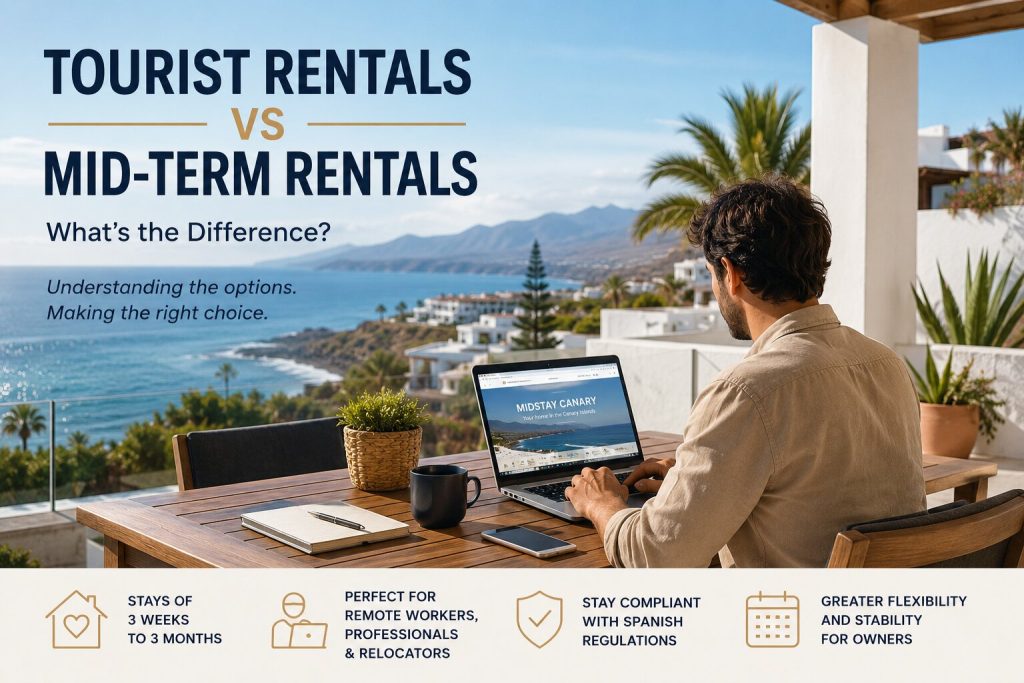
Understanding this distinction is becoming increasingly important, especially in regions such as the Canary Islands, where new regulations are affecting the operation of tourist accommodation.
What Is a Tourist Rental?
A tourist rental is a property rented to travellers for holiday purposes, typically for short stays ranging from a few days to a few weeks.
Tourist rentals are regulated by the tourism authorities of each Autonomous Community and generally require a tourism licence. Depending on the region, additional requirements may apply, including registration, inspections, insurance, and compliance with specific tourism regulations. In many areas of Spain, communities of owners can also restrict or prohibit new tourist rental licences.
What Is a Seasonal or Mid-Term Rental?
A seasonal rental (alquiler de temporada) is a temporary rental intended to satisfy a specific housing need that is not considered a person’s permanent residence.
These rentals are commonly used by remote workers, digital nomads, professionals on temporary assignments, students, people relocating to a new area, individuals undergoing medical treatment, families between property purchases or renovations.
Unlike tourist rentals, seasonal rentals are governed by Spain’s Urban Leasing Act (Ley de Arrendamientos Urbanos – LAU) rather than regional tourism legislation. They do not require a tourism licence because their purpose is not holiday accommodation.
Key Differences Between Tourist and Seasonal Rentals
Applicable Regulations
Tourist Rental
- Governed by regional tourism laws
- Usually requires a tourism licence
Seasonal Rental
- Governed by the Urban Leasing Act (LAU)
- No tourism licence required
Community Restrictions
In many regions, communities of owners can vote to limit or prohibit tourist rentals within their buildings.
Seasonal rentals are generally not subject to these tourism-specific restrictions because they fall under a different legal framework.
Why More Owners Are Considering Mid-Term Rentals
The Spanish rental market has changed significantly in recent years. Seasonal rentals have become increasingly popular as property owners seek flexibility while remaining compliant with evolving regulations. Market data shows strong growth in the seasonal rental segment across Spain.
For owners, mid-term rentals can offer several advantages:
- Fewer guest turnovers
- Lower management requirements
- Reduced cleaning and operational costs
- Stable monthly income
- Access to professionals and relocating tenants
- Flexibility between personal use and rental periods
Growing Demand in the Canary Islands
The Canary Islands continue to attract remote workers, international professionals, digital nomads, and individuals seeking temporary accommodation for periods ranging from a few weeks to several months.
At MidStay Canary, we are seeing increasing demand for stays between 3 weeks and 3 months, particularly from remote workers, professionals on assignment, families relocating to the islands, property buyers exploring an area before purchasing, long-stay visitors seeking more flexibility than a hotel can provide
Is Mid-Term Rental Right for Your Property?
If your property is not operating as a tourist rental, or if you are looking for an alternative rental strategy that focuses on temporary accommodation rather than holiday stays, mid-term rentals may be worth considering.
At MidStay Canary, we help property owners connect with qualified tenants looking for stays of 3 weeks to 3 months throughout the Canary Islands.
If you would like to learn more about listing your property, feel free to contact us and discover how MidStay Canary can help you reach a growing segment of the rental market.